
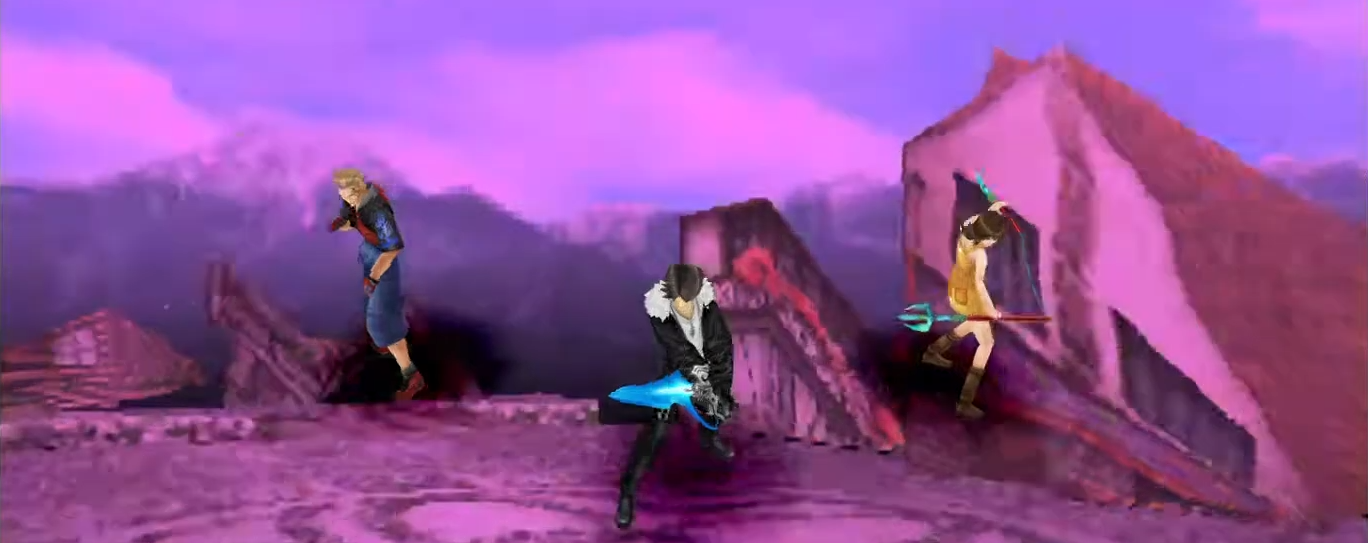
FF8 has plenty of set-piece boss battles, but one of the best is the extended battle that unfolds at the beginning of Disc 4. When Ellone initiates time compression, you are sucked into a battle against eleven sorceresses from history, rapidly shifting across time and space as you defeat them. “Succession of Witches” is a phrase that keeps popping up throughout Final Fantasy VIII, and here is a literal succession of witches. It fucking rules.
It’s cool enough that the battle changes scenery as you jump across spacetime every time you take out another witch. But what really makes the sequence work is that you’re not simply revisiting earlier scenes from the game. You’re visiting them in the process of them being time-compressed. They’re distorting, sinking, and collapsing, like one of those screensavers where the desktop melts. If it wasn’t clear what time compression was before, it’s certainly clear what it looks like during this battle.
There’s any number of ways they could’ve depicted Time Compression. They mostly leave the concept up to the imagination. When they attempt to depict it in the scene immediately before this battle, it looks like they’re floating inside a lava lamp the size of the universe. It could’ve been literally anything, but they chose to depict it on a way that draws on the graphical limitations of the original PlayStation.
The PlayStation Final Fantasy games used pre-rendered graphics for field scenes and real-time polygonal graphics for battle scenes. The difference in fidelity between these scenes is noticeable, because there’s only so much you could do with a PS1 in real-time.
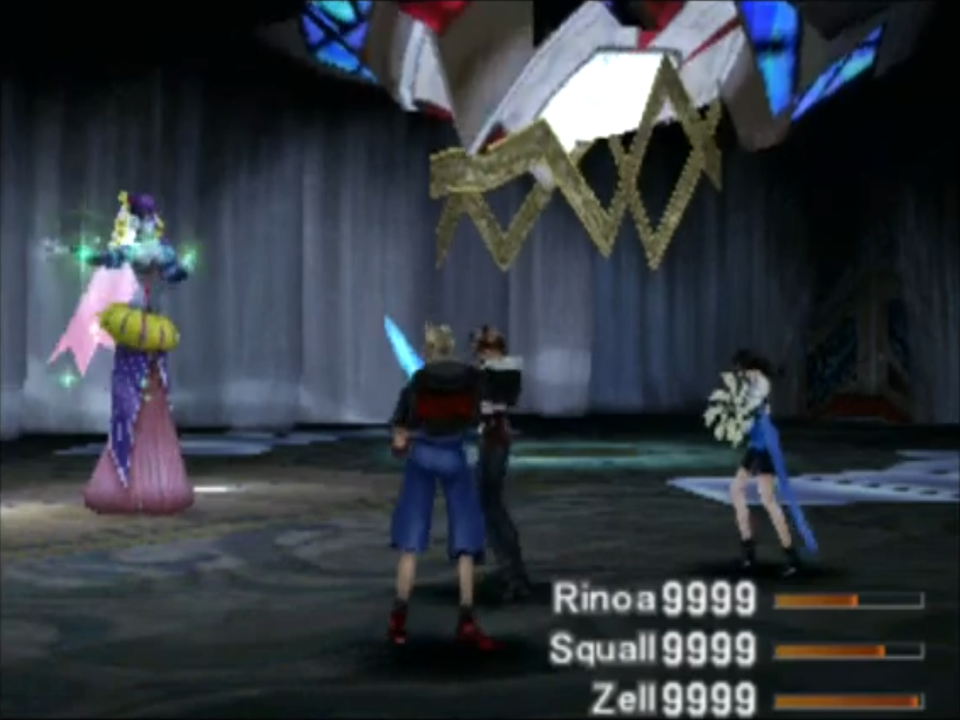
The Time Compression sequence plays into this brilliantly. In an era before shaders and fancy in-screen effects, how do you depict a low-polygon world losing cohesion? You manually distort it, one vertex at a time. For instance, in Edea’s chamber in Deling City, there’s a circular chandelier on the ceiling. The PS1 was not adept at making completely circular shapes in real-time, so the game takes advantage of that. As the battle in this scene progresses, the geometry gets sharper and more distorted. The polygons are even more visible than they were before. The low fidelity becomes an asset instead of a limitation. In other scenes, they make no attempt to hide the physical boundaries of the world revealed by the melting effect, making it obvious where the graphics end and the void begins.
The PlayStation 1 aesthetic has become popular among indie devs recently for its uncanny horror qualities, but there’s so much more you can do with it! This effect is creepy, but it also plays with your physical perception in a way that would be more difficult to do in a game with higher fidelity.